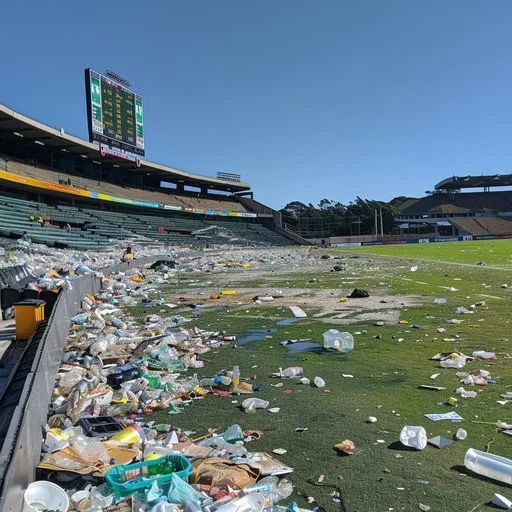
The psychological dynamics of human decision-making are rarely static; they shift depending on environmental context, emotional state, and immediate incentives. Lindenberg’s Goal-Framing Theory provides a framework for understanding why individuals behave pro-socially in some settings while completely disregarding social norms in others.
Nowhere is this contrast more stark than in UK football stadiums. Every weekend, thousands of supporters leave behind mountains of food packaging, plastic cups, and other rubbish. By applying Goal-Framing Theory to the matchday environment, we can understand the root causes of this behaviour and construct targeted strategies to mitigate it.
Understanding Goal-Framing Theory
Goal-Framing Theory sugges that human perception, processing of information, and subsequent actions are governed by whichever "goal frame" is currently dominant in a person's cognitive processing. Lindenberg categorises these into three primary goal frames:
The Hedonic Goal Frame ("To feel good right now"): Focuses on immediate mood improvement, pleasure, excitement, and the avoidance of effort or discomfort. It operates on short time spans and low cognitive effort.
The Gain Goal Frame ("To guard or improve one’s resources"): Focuses on personal efficiency, saving time, preserving money, or accumulating personal utility.
The Normative Goal Frame ("To act appropriately"): Focuses on social responsibility, adherence to collective rules, civic duty, and doing "the right thing" according to accepted moral or societal standards.
According to the theory, multiple goals are always present, but only one occupies the foreground as the primary driver of behaviour. The other two act in the background, either supporting or undermining the dominant frame. Situational cues dictate which goal frame moves to the foreground.
Goal-Framing Theory & UK Football Stadiums
On a matchday, a football stadium operates under conditions that systematically elevate hedonic and gain goals while suppressing normative goals.
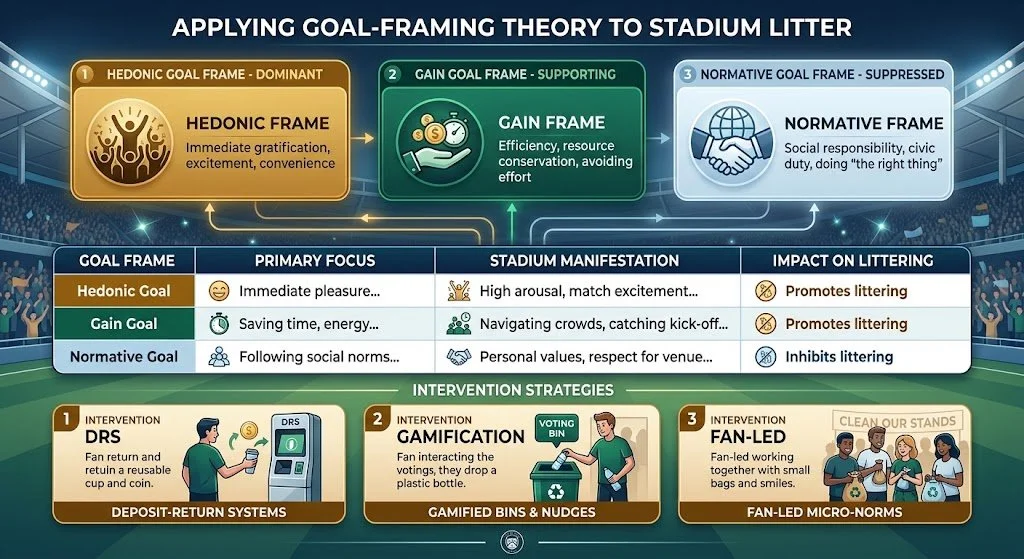
1. Overwhelming Dominance of the Hedonic Frame
Football stadiums are high-arousal environments. Fans attend matches to experience emotional highs, camaraderie, and intense excitement. Alcohol consumption, chants, tension, and collective celebration keep the hedonic frame firmly in the cognitive foreground.
When a fan finishes a pint or a pie, carrying the empty packaging while cheering or navigating a tight seating row creates a minor inconvenience. Because the hedonic frame prioritises instant comfort and emotional engagement, dropping trash onto the floor under one's seat resolves the inconvenience immediately.
2. Reinforcement by the Gain Frame
The gain frame in a stadium context centres on time and movement efficiency. Concourses and seating blocks are tightly packed. Finding a bin during half-time or post-match requires fighting through dense crowds, risking missing the start of the second half or missing a train home. Dropping litter on the spot saves time and physical energy, making littering an efficient choice under a gain-oriented lens.
3. Complete Suppression of the Normative Frame
In everyday life, normative frames are held in place by visible cues (spotless streets, explicit signage, social observation). In a football stadium, three factors collapse this normative frame:
The "Broken Windows" Effect: Once a few fans drop wrappers or spill beer, the physical space signals that littering is the local norm. The cognitive cost of holding onto trash rises because the social norm appears suspended.
De-individuation: Being part of a 40,000-strong crowd dilutes personal accountability. Anonymity reduces the perceived risk of social sanction.
Outsourcing Responsibility: Fans know paid cleaning crews sweep the stands immediately after the match. This allows fans to justify littering as "providing work" or standard stadium practice, effectively deactivating any residual moral guilt.
The Scale of the Problem
The physical consequence of these shifted goal frames is staggering. According to EIT Food (2025) on average, “a professional football match in Europe generates roughly 0.8 kg of waste per spectator. Across a 25,000-seat venue, that amounts to 20 tonnes of rubbish per single matchday.”
In the Premier League alone, total waste generation across a typical 380-match season is estimated at over 2,000 tonnes of waste. Major clubs with large venues generate significant shares of this volume; for instance, larger venues produce up to 8 tonnes of waste per match, accumulating to nearly 200 tonnes annually for a single ground across domestic and European fixtures. (Source: OnlineGambling.ca for COP26)
The vast majority of this waste consists of single-use plastic cups, food boxes, betting slips, and drink cans left directly under seats or on concourse floors.
How to tackle the problem?
To counter these three cognitive drivers: hedonic dominance, gain-frame efficiency, and normative suppression, stadium operators must redesign the physical environment and fan journey so that keeping the stadium clean aligns naturally with the fan experience. Easier said than done…
Here are 3 strategic recommendations designed to neutralise each psychological factor:
1. Gamify Disposal to Harness the Hedonic Frame
Rather than asking fans to step out of their high-arousal, emotionally driven state to perform a dull chore, integrate waste disposal directly into the excitement and competition of matchday.
Interactive "Voting Bins": Place large transparent bins at concourse exits and seat block entrances with two compartments, asking fun matchday questions ("Who was Man of the Match?" or "Will we score in the second half?"). Fans "vote" by dropping their empty cups or food containers into a specific side.
Target Practice & Fan Zone Challenges: Introduce target-style bins (resembling goal nets) on concourses. Turning the act of disposal into a playful, high-energy activity keeps the hedonic frame engaged while achieving the desired outcome.
Matchday Screen Highlights: Feature a brief, high-energy "Cleanest Stand of the Month" leaderboard on the stadium big screens during half-time to channel tribal pride into social competition.
2. Eliminate Friction to Satisfy the Gain Frame
Fans prioritise time and effort efficiency, especially in congested seating rows and tight concourses. If disposing of trash takes less effort than dropping it on the ground, fan behaviour shifts automatically.
High-Density Flow Bins: Position high-speed disposal channels directly along natural exit routes, at the top of every aisle, at stairwell landings, and at turnstile exits. Bins must feature wide, funnel-shaped openings so fans can drop items in mid-stride without stopping or slowing down the crowd.
Post-Match "Deposit-Return" Express Points: Implement a quick deposit-return system for plastic cups (return a cup to get £1 off a future ticket/merchandise or token entry into a halftime prize draw). Place rapid automated scan-and-drop kiosks near exits to make returning items a tangible financial gain.
3. Re-establish Social Norms to Activate the Normative Frame
To counteract de-individuation, the "broken windows" effect, and the belief that "cleaning staff will handle it," stadiums must make non-littering visible, personal, and socially expected.
The "Clean Slate" & Visible Pre-Match Messaging: Ensure the stadium is visibly immaculate when doors open, accompanied by clear, friendly messaging on big screens and LED boards featuring team captains or manager audio clips ("This is our home: keep it clean"). Leveraging respected club figures grounds personal responsibility in team identity.
"Pitch In" Nudges: Run a targeted 60-second big-screen countdown right after the final whistle urging fans to "Take 5 seconds to grab your trash and leave your row clean for the team." When thousands see peers picking up items simultaneously, the social norm instantly reactivates and de-individuation evaporates.
Transparent Impact Metrics: Counter the "outsourcing responsibility" belief by publishing post-match sustainability stats on the club's app and screen network ("Thanks to you, 85% of today's waste was recycled directly into new club gear"). Showing fans that their actions directly power club sustainability reframes fan cooperation as an active contribution rather than unpaid labour.