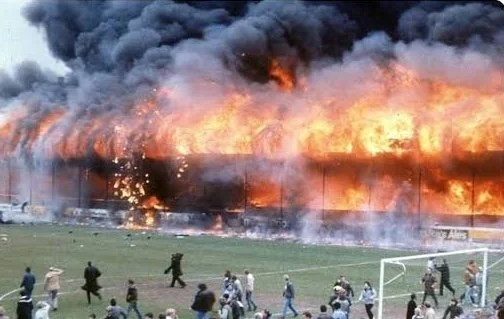
UK football stadiums have some of the strictest safety rules in the world. Today's sports stadiums are amazing pieces of engineering, designed to host tens of thousands of fans safely. However, this rigorous standard of safety was hard-won. The evolution of UK fire safety codes for sports venues was largely forged in response to tragedy, with the Bradford City stadium fire of 1985 serving as a critical turning point that transformed stadium architecture, statutory enforcement, and operational procedures across the nation.
The Bradford City Stadium Fire (1985)
On May 11 1985, during a match between Bradford City and Lincoln City at the Valley Parade stadium, a small fire broke out in the Main Stand. Believed to have been started by a discarded match or cigarette falling through gaps in the wooden floorboards onto accumulated litter beneath, the fire spread with catastrophic speed.
Within less than four minutes, the entire wooden grandstand, featuring an asphalt-covered bitumen roof and decades of combustible debris underneath was fully engulfed in flames. Toxic smoke filled the area, and spectators fleeing to the rear found turnstiles and exit doors locked to prevent ticketless entry. Tragically, 56 people lost their lives and over 260 were injured.
The subsequent inquiry, led by High Court Judge Sir Oliver Popplewell, exposed severe structural and operational failures:
Combustible Materials: The stand was built primarily of wood with a highly flammable roof coating.
Accumulation of Waste: Trash had gathered unhindered beneath the seating deck for decades.
Inadequate Egress: Locked turnstiles and exit gates obstructed rapid evacuation.
Lack of Preparedness: Venue staff lacked formal emergency training and immediate fire-fighting equipment.
The Popplewell Inquiry recommended sweeping changes to legislation, declaring that timber stands in major sports grounds should be banned or phased out, and establishing immediate safety protocols for crowds.
Legislative Frameworks and Regulations
Prior to 1985, sports grounds were partially regulated under the Safety of Sports Grounds Act 1975, which required designated grounds to obtain a Safety Certificate from local authorities. However, implementation was inconsistent, and many lower-division stands were exempt from strict oversight.
Following the Bradford disaster and subsequent tragedies such as the Hillsborough disaster in 1989 (which focused heavily on crowd control and physical barriers), the UK government systematically overhauled stadium regulation:
Fire Safety and Safety of Places of Sport Act 1987: This legislation extended the certification requirement to smaller grounds and covered stands capable of holding 500 or more spectators. It gave local authorities direct powers to inspect stands, demand structural alterations, and issue prohibition notices if conditions posed a threat to life.
The Green Guide: Officially titled A Guide to Safety at Sports Grounds, this government-backed publication became the definitive benchmark for stadium safety design and management. Updated through multiple revisions, the Green Guide details exact formulas for calculating safe capacity based on egress routes, seat pitch, staircase width, and structural fire resistance.
Regulatory Reform Fire Safety Order 2005: The pillar of fire safety law in England and Wales. The FSO shifted regulation toward risk management, requiring venue operators to designate a "Responsible Person" who must conduct, maintain, and continuously update a comprehensive Fire Risk Assessment.
Fire Safety Codes and Football Stadia
Applying modern UK fire safety codes to football grounds requires a multi-layered approach combining structural resilience, active suppression systems, and strict crowd management protocols.
1. Fire Compartmentation and Structural Protection
Modern football stadia are constructed almost entirely from non-combustible materials such as reinforced concrete and structural steel. Buildings are divided into fire-resisting compartments (using fire doors, fire-stop seals, and intumescent coatings) to contain smoke and flames for specified periods (for example; 60 to 120 minutes), allowing safe evacuation of adjacent sectors.
2. Evacuation Design and Egress Routes
Egress calculations dictate the permitted capacity of every stand. Under the Green Guide and Building Regulations:
Spectators must be able to clear individual seating tiers and enter a protected exit route or area of reasonable safety within set timeframes (typically within 8 minutes for open-air stands, or significantly faster for enclosed concourses). You can link this to the DIM ICE model.
Turnstiles and exit gates must never be locked while spectators are inside the stadium unless equipped with automatic panic-bar releases that open under pressure or trigger automatically during a fire alarm activation.
3. Active Fire Detection and Alarm Systems
Stadia are fitted with sophisticated addressable fire detection systems, including optical smoke detectors, heat sensors in high-risk zones (such as commercial kitchens, plant rooms, and server infrastructure), and manual call points. These feed directly into a central Control Room manned throughout matchdays. Multi-stage alarms allow control staff to verify a signal before initiating a full stadium evacuation or phased zone-by-zone rollout.
4. Operational Management and Fire Risk Assessments
Fire safety is an operational duty as much as a structural requirement. Under the Regulatory Reform (Fire Safety) Order 2005, stadium management must:
Maintain clean concourses and voids, preventing the buildup of combustible rubbish.
Conduct regular fire safety training for matchday stewards and security staff.
Coordinate closely with local Fire and Rescue Services, local authority building control, and safety advisory groups (SAGs) to maintain a valid Safety Certificate.
Summary
Historical Catalyst: The 1985 Bradford City stadium fire exposed critical risks associated with combustible timber stands and restricted exit routes, prompting the Fire Safety and Safety of Places of Sport Act 1987 and a complete modern overhaul of UK sports ground regulation.
Modern Standards: Today, UK football stadia adhere to the Regulatory Reform (Fire Safety) Order 2005 and the Green Guide, enforcing non-combustible construction, strict evacuation time limits, active detection systems, and continuous Fire Risk Assessments overseen by local Safety Advisory Groups.