Value Captures Framework
Dolles and Söderman developed the Network of Value Captures framework to explain how football clubs create competitive advantage through a system of interconnected value-generating activities rather than through a single product or revenue source. Their work emerged from the recognition that professional football clubs are not simply sports teams but complex business organisations operating within entertainment, media, community, and commercial ecosystems.
The central argument of the theory is that a football club does not offer one product. Instead, it manages a network of value captures, where different assets, stakeholders, and activities interact to create and capture value. Competitive advantage arises from how effectively a club coordinates these elements and transforms them into economic and sporting success.
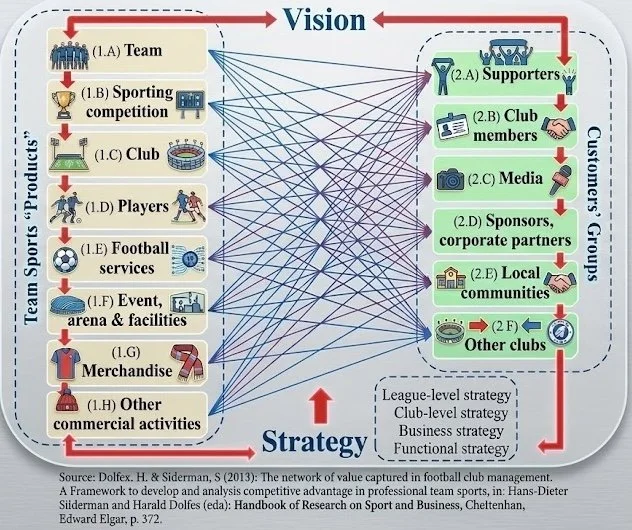
Dolles and Söderman’s framework
The Three Components of the Network of Value Captures
Dolles and Söderman identify three core dimensions:
1. Value Offerings (Value Captures)
The framework proposes that football clubs possess multiple value captures rather than a single product. These include:
Team
Sporting competitions
Club brand
Players
Football services
Events, facilities, and stadiums
Merchandise
Other commercial activities
These assets create value both independently and through interaction with one another. For example, successful players enhance the team's performance, which strengthens the club brand, increases merchandise sales, attracts sponsors, and improves media interest.
2. Customer Categories
The framework identifies six key customer groups:
Spectators and supporters
Club members
Media organisations
Sponsors and corporate partners
Local communities
Other clubs
Each stakeholder extracts value from the club in different ways. Supporters seek entertainment and identity, sponsors seek brand exposure, broadcasters seek content, and other clubs participate in transfer markets. Effective clubs tailor value propositions to each group.
3. Vision and Strategy
The third component concerns managerial coordination. Clubs need a coherent vision linking their value captures and stakeholder relationships. Strategic decisions determine how resources are allocated, how the brand is positioned, and how sporting and commercial objectives reinforce each other.
Applying the Framework
The modern football industry provides numerous examples of the Network of Value Captures in practice.
Team and Sporting Success
Sporting performance remains the foundation of value creation. Manchester City's success (at the time of writing they are relatively successful) demonstrates how on-field achievements increase broadcasting revenues, sponsorship attractiveness, and global fan engagement.
Winning domestic leagues and participating regularly in the UEFA Champions League increases prize money and media exposure while strengthening commercial partnerships. Sporting success therefore acts as a catalyst connecting multiple value captures.
Players as Value Captures
Players function as both sporting assets and commercial brands. Lionel Messi at [any club] and Cristiano Ronaldo at Real Madrid significantly increased shirt sales, sponsorship opportunities, media attention, and global fan growth.
Paris Saint-Germain's acquisition of Messi illustrates this principle. Beyond football performance, the transfer generated worldwide media exposure and social media growth, enhancing the club's brand value. The player became a value capture interacting with sponsors, broadcasters, supporters, and merchandise sales simultaneously. The same can be said when Messi signed for Inter Miami.
Club Brand
The world's largest clubs have transformed themselves into global brands. Manchester United, Liverpool, Barcelona, Bayern Munich, and Real Madrid operate far beyond their local markets.
For example, Manchester United's commercial strategy has historically relied on hundreds of millions of supporters worldwide and extensive sponsorship portfolios. The club's ability to monetise its global identity demonstrates how the club brand itself becomes a major value capture independent of match results.
Stadium and Matchday Experience
Dolles and Söderman identify facilities and arenas as critical value captures. Modern clubs increasingly view stadiums as year-round entertainment venues rather than matchday-only assets.
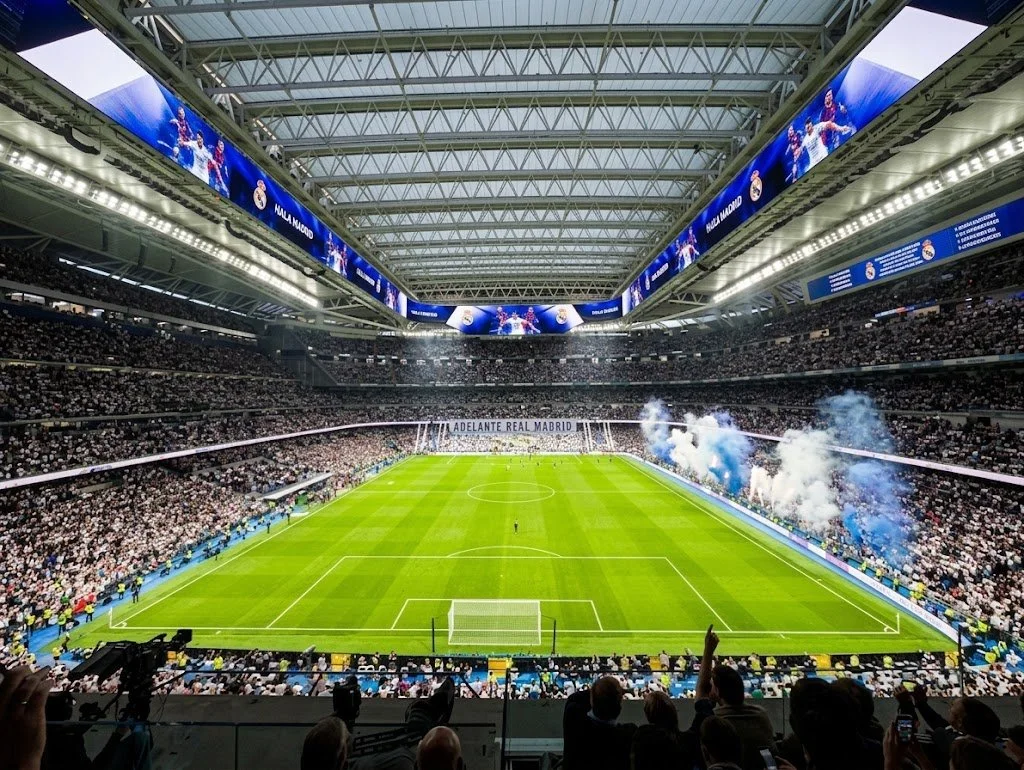
Tottenham Hotspur Stadium exemplifies this approach through concerts, NFL games, hospitality services, conferences, and premium experiences. Similarly, Santiago Bernabéu's redevelopment has significantly expanded Real Madrid's revenue-generating opportunities. Deloitte (2026) highlights that stadium utilisation and premium matchday offerings are becoming major drivers of football revenue growth.
Sponsors and Corporate Partners
Commercial partnerships represent another important network node. The relationship is symbiotic: sponsors gain visibility while clubs receive financial resources.
Examples include Emirates with Real Madrid, Adidas with Bayern Munich and Real Madrid, and Etihad with Manchester City. These partnerships rely on the club's ability to deliver global audiences and brand associations, illustrating how sponsors become integrated into the broader value network.
Which Football Club Captures Value Best?
Using the Network of Value Captures framework, Real Madrid appears to be the football club that captures value most effectively. But, this is based on sources publicly available. Several reasons support this conclusion.
Integration of Multiple Value Captures
Real Madrid excels across all major value captures identified by Dolles and Söderman:
Elite team performance
Global club brand
Star players
Commercial activities
Merchandise
Stadium operations
Worldwide fan engagement
Rather than depending on a single revenue source, Real Madrid successfully monetises all dimensions of the network.
Strong Stakeholder Management
Real Madrid creates value for every major stakeholder group:
Fans receive consistent sporting success.
Sponsors receive global exposure.
Broadcasters benefit from high audience demand.
Members maintain influence through the club's ownership model.
Local communities benefit from tourism and economic activity.
This balance closely reflects the stakeholder relationships envisaged within the Network of Value Captures framework.
Financial Performance
Deloitte's Football Money League reported that Real Madrid became the first football club to exceed €1 billion in annual revenue during the 2023/24 season. Revenue growth was driven by commercial activities, matchday income, and the renovated Bernabéu Stadium.
This achievement is significant because the Network of Value Captures is fundamentally about maximising value creation across interconnected assets. Real Madrid demonstrates exceptional performance across commercial revenue, broadcasting income, sponsorships, retail, events, and fan engagement rather than relying on a single stream.
Strategic Vision
Perhaps most importantly, Real Madrid has maintained a long-term strategic vision. Investments in star players, global branding, digital engagement, and the Bernabéu redevelopment have reinforced each other. This coordination reflects the strategic dimension at the heart of Dolles and Söderman's model.
Conclusion
The Network of Value Captures provides one of the most comprehensive frameworks for understanding football club management. Rather than viewing football clubs as organisations selling matches, Dolles and Söderman argue that clubs manage interconnected value captures involving teams, players, brands, facilities, merchandise, sponsors, media organisations, supporters, and communities. Competitive advantage emerges from the effective coordination of these elements.
Applied to modern football, the theory explains why clubs such as Real Madrid, Manchester City, Bayern Munich, and Manchester United generate extraordinary revenues. Among them, Real Madrid currently represents the strongest example of value capture, as it successfully integrates sporting success, global branding, stadium utilisation, sponsorships, media appeal, and fan engagement into a coherent network that generates both competitive and financial advantage.