
The European Accessibility Act (EAA) is a landmark legislative framework designed to create unified accessibility standards across EU member states. Enforceable across the Union, the Directive covers products and services deemed essential for modern public life. While the legislation focuses heavily on digital products, telecommunications, banking, and e-commerce, its reach extends deeply into live experiences, including sports events and sports venues.
The European Accessibility Act and Sports Events
The EAA links to sports events through two primary mechanisms:
Digital entry points
Operational event environment.
1. Digital Fan Infrastructure & E-Commerce
The European Accessibility Act mandates that all e-commerce platforms, ticketing services, and customer-facing software meet WCAG 2.1 AA standards (governed under European standard EN 301 549). A bit technical, but what it means for a sports organisation, is that it needs to address the following:
Ticketing Systems: Fan websites, mobile apps, seat selection tools, and checkout flows.
Digital Passes: Smart ticketing, digital wallet passes, and mobile access controls.
Media Coverage: Live match streams, archived match highlights, and digital club media, which require captioning, screen-reader compatibility, and audio description services.
2. On-Site Physical Terminals and Audio Interfaces
The European Accessibility Act explicitly covers hardware terminals and electronic communications equipment used during live events. Venue-based hardware subject to the act includes:
Self-Service Check-In & Ticket Kiosks: Must feature tactile controls, adjustable display heights, and screen-reading capability for visually impaired fans.
Point-of-Sale Terminals: Concession stands and fan stores must use accessible payment hardware.
Audio-Visual Announcements: Public address systems and in-stadium media must interface with assistive listening systems (hearing loops, Bluetooth/Auracast streaming).
Key Issues and Concerns for Sports Venues
Sports operators face several complex challenges when bringing legacy venues and digital ecosystems into compliance.
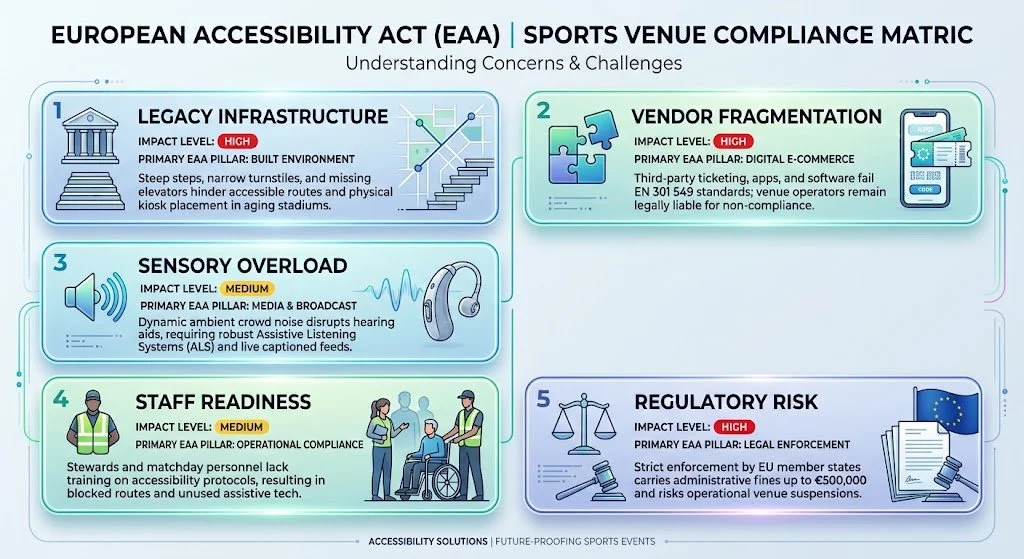
Three Strategic Recommendations for Venue Operators
To mitigate legal exposure and deliver a seamless matchday experience for fans with disabilities, sports venues and event organisers should execute three core initiatives:
1. End-to-End Digital Audit and Procurement Enforcement
Venue operators must audit the entire digital journey; from purchasing a ticket online to scanning a mobile pass at the gate.
Action: Contract independent accessibility specialists to run audits against EN 301549 standards (ICT accessibility standards set by the EU) across web platforms, native mobile apps, and interactive venue maps.
Vendor Mandates: Update all third-party procurement contracts (ticketing partners, merchandise vendors, point-of-sale software) to require legal guarantees of EAA compliance, passing compliance liabilities to software providers where appropriate.
2. Modernise On-Site Assistive Listening & Terminal Hardware
Physical kiosks and audio broadcasts require modern technical upgrades to meet EU standards.
Action: Upgrade venue audio infrastructure to include multi-channel Assistive Listening Systems (ALS) such as Hearing Loops or next-generation Auracast / Audio-over-WiFi solutions.
Terminal Retrofits: Replace or retrofit self-service ticketing kiosks and concession payment terminals with units that offer low-level physical access, screen-reading functionality, tactile pads, and high-contrast screens.
3. Establish Matchday Operations & Staff Training Programmes
Technology alone cannot deliver inclusion; frontline matchday staff must be trained to support fans with varied accessibility needs.
Action: Implement mandatory accessibility training for all stewarding, ticketing, and concession staff. Staff must be trained in assisted entry protocols, basic sign language/alternative communication techniques, and troubleshooting on-site assistive listening devices.
Feedback Mechanism: Create an accessible, real-time reporting system (via app or SMS) where fans can report matchday accessibility barriers immediately to stadium operations.