
The Private Security Industry Act 2001
The Private Security Industry Act 2001 was enacted to regulate the private security sector across England, Wales, Scotland, and Northern Ireland. Prior to the Act, the UK private security industry operated largely without statutory oversight, leading to concerns regarding criminality, poor training, and variable standards among security personnel.
The Act established the Security Industry Authority (SIA) as an independent regulator under the Home Office. The SIA's primary statutory duties include:
Licensing Individuals: Standardising compulsory licensing for key roles such as door supervisors, security guards, CCTV operators, close protection officers, and cash-in-transit staff.
Criminal Record & Identity Checks: Preventing individuals with serious criminal records or those lacking the right to work from holding positions of trust.
Setting Training Standards: Requiring applicants to complete accredited qualifications in conflict management, physical intervention, and emergency protocols before receiving a license.
Approved Contractor Scheme: Maintaining a voluntary quality assurance framework for private security companies to promote best practice.
Private security industry act & Sports Stadiums
While the Private Security Industry Act covers most commercial security activities, its application within sports stadiums is uniquely nuanced due to Section 4(6), commonly known as the Sports Ground Exemption.
Under Section 4(6), staff employed directly by ground management at a sports venue certified under the Safety of Sports Grounds Act 1975 or the Fire Safety and Safety of Places of Sport Act 1987 are exempt from SIA licensing when performing safety or crowd monitoring duties. Ground management remains accountable under the Safety Advisory Group framework and the Sports Grounds Safety Authority (SGSA.org.uk) Green Guide.
If a stadium outsources its security or stewarding to a third-party contractor, those external guards must hold a valid SIA licence if performing licensable tasks (such as door supervision, searching, or ejecting individuals).
Purpose of the Act in Stadium Operations
The primary purpose of applying the Private Security Industry Act within sports venues is to balance public safety with operational feasibility:
Professionalising Access Control: Ensures that specialised security functions (searching at turnstiles, managing aggressive behaviour, response teams) are handled by trained, background-checked personnel.
Proportionate Cost Structure: The Section 4(6) exemption allows sports clubs to retain part-time, directly employed matchday stewards without imposing the prohibitive financial and administrative costs of SIA licensing on every volunteer or casual worker.
Accountability: Establishes clear legal liabilities for third-party security firms supplying venue staff, deterring illicit labour practices.
Vulnerabilities & Areas for Improvement
Despite its framework, the application of the Private Security Industry Act to sports venues suffers from structural flaws:
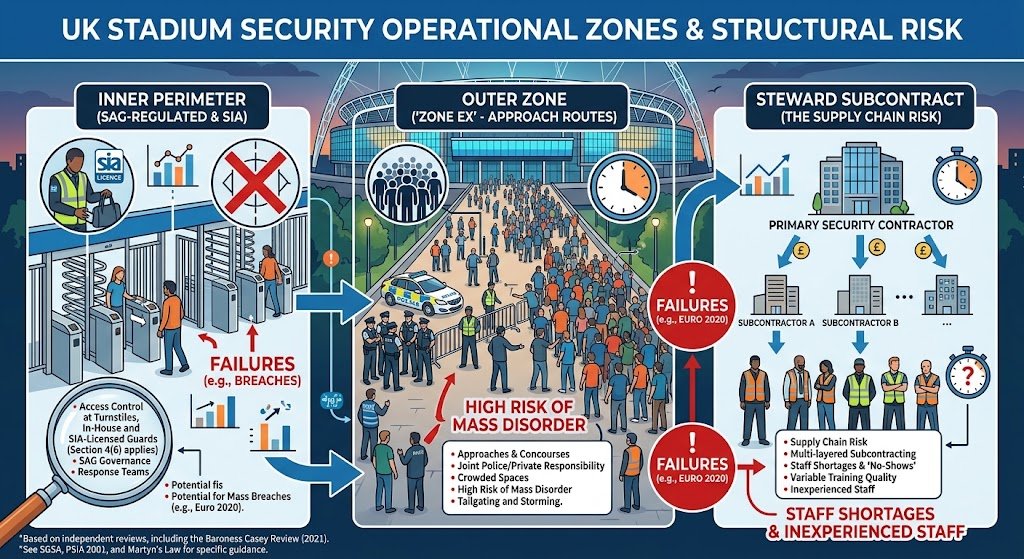
The "In-House" Training Gap. Exempt in-house stewards often receive lower, non-standardised training compared to SIA-badged guards, despite handling similar high-stress crowd events. Recommended improvements are a standardised statutory minimum safety training for all stewards regardless of employment model.
Source: Sports Grounds Safety Authority (SGSA), SIA Stewarding Exemption Policy Guidance & Green Guide (6th Edition). The SGSA explicitly defines the "Sports Ground Exemption" under Section 4(6) of the PSIA 2001. While SIA licence holders must undergo standardised national training (think of, Door Supervision Level 2 qualifications), in-house stewards rely on individual venue enforcement for equivalent standards. The SGSA and organisations like Level Playing Field highlight that inconsistent training levels across different venues create vulnerabilities during high-risk crowd situations.
Over-Reliance on Subcontracting. Major clubs often hire primary contractors who subcontract to secondary agencies, diluting SIA license verification and oversight. Recommended improvements are to mandate strict limits on supply-chain subcontracting for stadium security contracts.
Source: Baroness Casey Review (2021), An Independent Review of Events Around the UEFA EURO 2020 Final Match: Chapter 4 of the Casey Review documents the widespread reliance on third-party security contractors and sub-contractors at major venues. The review identified that multi-layered subcontracting dilutes vetting oversight, leads to low pay and poor retention, and results in severe under-staffing on event days when low-wage agency staff fail to show up.
Ambiguity in Dual Roles. The line between "customer service stewarding" (exempt) and "security door supervision" (SIA required) creates operational confusion on matchdays. Recommended improvements are to clarify legal definitions distinguishing safety stewards from security personnel in public venues.
Source: SGSA Factsheet 6 (SIA Stewarding Exemption for Sports Grounds): This official regulatory guidance details the complex line between "licensable activities" (which require an SIA license or equivalent vetted status, such as searching, physical intervention, or ejections) and general spectator management (advising, vomitory management). Industry reports note that in fast-moving stadium environments, non-licensable stewards are frequently forced into conflict management situations for which they are legally and practically unprepared.
Zone Ex Governance Gap. SIA jurisdiction ends at venue perimeters; security outside stadium boundaries ("Zone Ex") is often fragmented between police and private vendors. Recommended improvements are to extend coordinated multi-agency security standards into public approach routes.
Source: The UK Football Policing Unit (UKFPU) & The Casey Review (2021): The Casey Review specifically flagged the legal and operational "vacuum" in Zone Ex (the public spaces immediately surrounding the stadium perimeter before turnstiles). Because the SIA framework applies to licensed premises/venues and police powers apply to public highways, the outer concourses often suffer from fragmented accountability between private security vendors, local authority safety advisory groups (SAGs), and police forces.
Implementation Failure: EURO 2020 Final (Wembley Stadium)
The most prominent failure of stadium security governance and SIA-regulated stewarding in recent British sports history occurred at Wembley Stadium on July 11, 2021, during the UEFA EURO 2020 Final between England and Italy.
Detailed Breakdown of the Failure Baroness Louise Casey conducted an independent review into the events, concluding that the day was characterised by "collective failure" that nearly resulted in serious injuries or loss of life.
Stewarding Shortages and Low Experience: Due to the COVID-19 pandemic and low industry wages, security providers struggled to supply experienced, SIA-licensed staff. Many scheduled stewards failed to show up, leaving entry points drastically undermanned.
Qualitative Standard Breakdown: Third-party security personnel lacked the training to manage mass public disorder. Confronted by thousands of aggressive, ticketless fans, many stewards abandoned their posts or were easily overpowered.
Exploitation of Weak Exemption Boundaries: The breakdown illustrated how vulnerable venues become when relying on a mixed workforce of poorly paid contract stewards (SIA-licensed) and event stewards who were undertrained for severe public order threats.
Physical and Operational Breaches: Over 6,000 ticketless fans breached outer perimeter turnstiles, disabled emergency exits, and forced entry through disabled access gates.
Consequences
Safety Violations: Disabled fans were intimidated, emergency exits were compromised, and concourses became dangerously overcrowded, creating serious crush hazards.
Sanctions: UEFA fined the FA £84,500 and ordered England to play their next UEFA competition match behind closed doors.
Legislative Action: The event exposed significant enforcement gaps in perimeter security, driving momentum for statutory updates to venue security obligations and football banning orders for stadium breaches.
Summary
The Private Security Industry Act 2001 regulates UK private security through the Security Industry Authority (SIA), mandating licensing, background checks, and standardised training. Key weaknesses include inconsistent training standards between exempt stewards and SIA guards, heavy subcontracting that dilutes oversight, and governance gaps in outer stadium zones. This was demonstrated at the EURO 2020 Final at Wembley, where severe stewarding shortages, undertrained contract staff, and perimeter failures led to mass crowd disorder, fine sanctions, and stadium closures.