The Network of Value Captures framework by Dolles & Söderman, replaces linear business models by mapping a football club's operations across interconnected value offerings, diverse customer segments, and strategic vision. It identifies dozens of unique "value captures", such as media rights, sponsorships, and ticketing, allowing executives to see how a single asset or decision impacts multiple revenue streams simultaneously. Ultimately, this approach helps clubs strategically bundle their offerings to maximise both global financial returns and local fan engagement within a complex sports ecosystem.
Applying the Network of Value Captures framework to technology in football highlights how digital transformation is no longer just an operational upgrade; it is a core driver of modern competitive advantage. By intersecting a club's multi-dimensional value propositions with its various customer segments, technology acts as the ultimate catalyst for creating new "value captures."
Core dimensions
Here is how technology maps across the framework’s core dimensions:
1. Enhancing Value Offerings (The Product)
Technology has changed what a football club can offer.
The Live Match/Event: Upgrading stadiums into "smart stadiums" (high-speed 5G connectivity, contactless mobile ordering, cashless entry) significantly enhances the live matchday product.
Media & Content: Direct-to-Consumer (D2C) over-the-top (OTT) streaming platforms allow clubs to broadcast proprietary content, behind-the-scenes documentaries, and youth academy matches globally, bypassing traditional TV networks.
The Sport/Athletic Product: On-pitch technology (wearable GPS trackers, AI-driven tactical software, advanced biometric medical screening) maximises player performance, prevents injuries, and optimises squad value, the very foundation of the club's appeal.
2. Diversifying and Reaching Customer Segments
Technology expands a club's ability to capture value from an increasingly fragmented customer base, shifting from local fanbases to a complex web of global stakeholders.
Global Fans: Social media algorithms, localised digital content, and translation technologies allow elite European clubs to engage millions of fans across Asia, the Americas, and Africa, converting casual interest into merchandise or digital subscription sales.
Sponsors and Corporate Partners: Traditional static billboard advertising is replaced by dynamic, targeted LED boards using virtual advertising technology. This allows a club to broadcast different sponsors to television viewers in different regions during the exact same match, drastically increasing the value captured from the corporate segment.
The Local Community: Digital ticketing networks and community engagement apps lower the friction for local fans to access matchday events, preserving the club's authentic cultural core.
3. Activating "Bundled" Value Captures
The true power of the framework lies in how technology allows a club to bundle activities to capture value across multiple streams simultaneously. For example:
The Connected Ecosystem: When a club signs a player based on algorithmic data scouting (On-Pitch Tech), they immediately leverage that player's massive personal social media following via digital marketing (Media/Fan Tech). This simultaneously triggers localised online jersey sales (Merchandising Tech) and enables the club to negotiate higher-tier regional sponsorships (Corporate Capture).
Ultimately, embedding technology into the Network of Value Captures ensures that a club's management can execute a highly coordinated, data-driven strategy that translates on-pitch performance into sustainable, global commercial revenue.
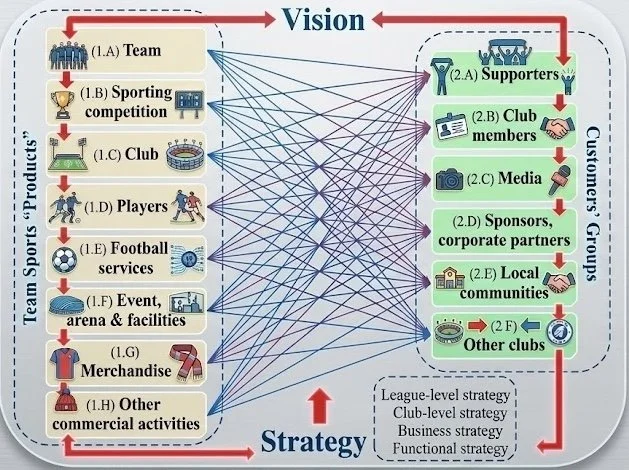
Dolles & Söderman’s Value Captured framework
Historically, sports stadiums were viewed through a Goods Dominant (G-D) Logic lens: physical structures built to house a 90-minute football match, where clubs sold static goods such as seats, tickets, pies, and physical merchandise. Applying Service Dominant (S-D) Logic transforms a stadium from a static venue into a dynamic, platform-based service ecosystem designed for continuous value co-creation.
1. From Physical Venue to Experiential Service Platform
Under G-D Logic, the stadium is an operand resource (concrete and steel). Under S-D Logic, the venue acts as a service platform. The physical infrastructure, supplemented by operant resources like high-speed 5G networks, seamless ticketing technology, and cashless payment systems, serves as a foundation for delivering personalised experiences. The goal shifts from filling seats to facilitating frictionless, memorable interactions from the moment a supporter leaves home until long after the event ends. An operand is an input that an operation is performed on, whereas an operant is an active agent or dynamic resource that produces an effect by acting on something else
2. Fans as Co-Creators of the Matchday Experience
In a stadium context, the core product is not just the athletic performance on the pitch; it is the atmosphere, the collective experience. The stadium operator provides the platform (light shows, acoustics, seating layout), but the fan brings essential operant resources: passion, chants, attire, and collective energy. Without active fan participation, the stadium experience loses its primary appeal. The electric atmosphere of a derby match is a direct result of value co-created between the stadium platform and the active crowd.
3. Shifting from Value-in-Exchange to Value-in-Use
A ticket purchase represents mere value-in-exchange. The true value [value-in-use] is realised through the interactive touchpoints enabled inside the venue:
Interactive Fan Zones: Pre-game activations where fans engage with interactive gaming, live entertainment, and customised food offerings.
Digital Integration: Mobile apps offering real-time replays, seat-side food delivery, and augmented reality stat tracking, enriching how fans consume the live spectacle.
Community Hubs: Modern stadiums operate beyond matchdays as 365-day community hubs (hosting concerts, corporate conferences, and community sports), extending the value-in-use across diverse stakeholder groups.
4. Ecosystem Resource Integration
A stadium's success depends on coordinating multiple ecosystem actors:
Sponsors & Brands: Moving away from static billboard banners toward interactive, immersive fan experiences integrated directly into the stadium concourse.
Local Community & Municipalities: Utilising smart stadium transport networks to mitigate local traffic congestion and stimulate local precinct businesses on non-event days.
Strategic Implications for Stadium Operations
By adopting an S-D Logic perspective, venue operators pivot away from transactional ticket sales toward relationship management. When stadiums invest in operant resources, such as customer data analytics, personalised fan engagement apps, and staff service training, they enable fans and corporate partners to co-create rich, memorable experiences. Ultimately, this approach turns stadium visitors from passive spectators into active, loyal partners who drive long-term commercial sustainability and emotional connection.
To transition from viewing a stadium as a static physical asset to a dynamic service ecosystem, venue operators must prioritise value co-creation, digital integration, and relationship management.
Stadium examples
1. Transform the Venue into an Interactive Service Platform
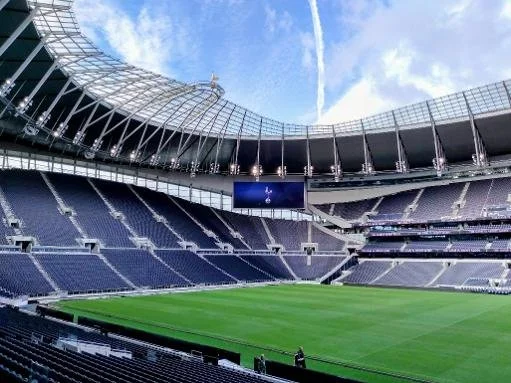
Activate non-event spaces: Tottenham Hotspur Stadium built the "Goal Line Bar" (Europe's longest continuous bar) and an on-site microbrewery (Beavertown) in its massive South Stand atrium, encouraging fans to arrive up to three hours before kickoff to socialise.
Empower attendee contribution: Borussia Dortmund’s Signal Iduna Park works directly with the fan collective Südtribüne Dortmund to supply infrastructure, hoisting points, and dedicated concourse storage for massive, fan-created tifos and choreographed stadium chants.
Treat infrastructure as a facilitator: Mercedes-Benz Stadium (Atlanta Falcons/Atlanta United) introduced $2 hot dogs and $3 refillable sodas via a high-efficiency layout, eliminating long lines and removing queueing frustrations.
2. Leverage Operant Resources & Digital Integration for Value-in-Use
Deploy smart stadium tech: SoFi Stadium (Los Angeles Rams/Chargers) features an end-to-end 5G network paired with 100% optical digital ticketing and cashless concessions, allowing over 70,000 fans to stream, order, and pay without network bottlenecks.
Enhance the live spectacle: The Minnesota Twins integrated augmented reality within their MLB Ballpark app, allowing fans in their seats to point their phones at the field to view real-time pitch speeds, hit trajectories, and player metrics.
Utilise real-time data analytics: Real Madrid's Santiago Bernabéu Stadium uses heat-mapping sensors and real-time point-of-sale data to dynamically redirect concourse foot traffic and adjust concession staff allocations during peak halftime rushes.
3. Orchestrate a Connected Multi-Stakeholder Ecosystem
Shift from static to experiential sponsorship: Red Bull Arena (RB Leipzig) replaced static perimeter advertising boards with interactive gaming lounges and product test zones on the stadium concourse, turning sponsor exposure into hands-on fan experiences.
Integrate local infrastructure: Manchester City developed the Etihad Campus in direct alignment with Manchester City Council, integrating tram lines, local bus networks, and local food vendors into a unified matchday transport and hospitality ecosystem.
Maintain 365-day engagement: Wembley Stadium functions as an all-year music and entertainment venue, hosting major international concerts, NFL London games, and corporate conferences to drive economic activity on non-match days.