FIFA has been in the news a lot lately. Search for ‘FIFA’ on Google News and none of the articles are very positive. Something to do with Infantino setting up FIFA Forward Enterprise, huge sums of money, and behind the scene deals. But how is this possible?
Some articles claim that FIFA is a monopoly within a very lucrative football market. So, is it possible to apply the Structure-Conduct-Performance model (Mason, 1939, 1949 and Bain, 1959) to FIFA? Let’s try….
FIFA and the SCP model
The Structure-Conduct-Performance (SCP) model is an industrial organisation framework used to analyse the relationship between market structure, firm behaviour (conduct), and economic results (performance). The model argues that the 3 elements influence each other: Market structure affects behaviour and eventually performance. Behaviour can also impact structure and performance, and performance can influence structre and behaviour. In short, the SCP model is also the CPS and PSC model.
Applying the SCP framework to FIFA gives us an idea how an international governing body leverages a natural monopoly structure to shape strategic conduct and generate unprecedented financial results. Each element starts with the academic principles behind the theory after which it is applied to FIFA. The information used comes from news articles and online sources.
Market Structure
Market structure refers to the operational conditions, entry barriers, and overall organisation of an industry. Key attributes include seller concentration, product differentiation, vertical integration, and barriers to entry.
Monopoly: FIFA operates as a global natural monopoly over international football. Through its network of six regional confederations: AFC (Asia), CAF (Africa), UEFA (Europe), CONMEBOL (South America), CONCACAF (North/Central America and Caribbean) and OFC (Oceania), and over 200 national associations, FIFA maintains absolute control over the international rulebook, officiating, calendar scheduling, and tournament hosting rights.
Barriers to Entry: The barriers to establishing a competing global football association are nearly impossible. Network effects dictate that all top international players, national teams, and leagues must operate under FIFA’s umbrella to participate in premier international competitions.
Vertical Integration: FIFA holds exclusive ownership of the intellectual property (IP) for major events, like the FIFA World Cup and FIFA Women's World Cup, allowing it to dictate terms across broadcasting, sponsorship, and merchandising markets.
Strategic Conduct
Market structure directly influences how an organisation behaves. Think of their strategies, pricing decisions, marketing efforts, and political tactics that organisation execute to maximise value or power.
Capturing wealth and excess profits: FIFA leverages the high demand for its flagship products by running competitive bidding processes for hosting rights and broadcast coverage. Countries compete against each other, offering tax exemptions, infrastructure investments, and legal concessions to secure hosting rights. You can think of the selection processes for Qatar 2022 and North America 2026.
Tiered Commercial Partnerships: FIFA employs exclusive sponsor categorisation such as FIFA Partners, World Cup Sponsors, and Regional Supporters. Major global brands (Adidas, Coca-Cola, Visa and others) pay multi-million dollar annual fees to secure worldwide promotional exclusivity within their respective sectors, effectively locking out competitors.
Product Expansion and Redesign: To sustain high revenue growth, FIFA continuously expands its structural footprint. Recent examples include expanding the FIFA World Cup from 32 to 48 teams in 2026, launching a 32-team FIFA Club World Cup, and restructuring digital licensing after moving away from long-term exclusive video game agreements (such as the historic EA Sports franchise).
Performance: Economic and Organisational
Performance measures the ultimate economic, societal, and financial outcomes generated by the industry's structure and firm conduct.
Enormous Financial Revenues: FIFA's structural monopoly and aggressive commercial strategy generate extraordinary financial returns. Driven by World Cup broadcasting rights and commercial sponsorships, FIFA recorded over $7.5 billion in revenue for the 2019–2022 commercial cycle, exceeding initial projections.
Global Reinvestment and Development: As a non-profit organisation registered under Swiss law, FIFA channels a significant portion of its surplus back into football development globally. Through the FIFA Forward program, funds are distributed to member associations to build infrastructure, develop youth academies, and foster women's football in developing regions.
Governance Challenges and Market Inefficiencies: The concentration of power and wealth within a single non-governmental entity has historically led to rent-seeking and corruption vulnerabilities, as evidenced by the 2015 FIFA corruption cases involving bribery and kickbacks for media rights and host selection.
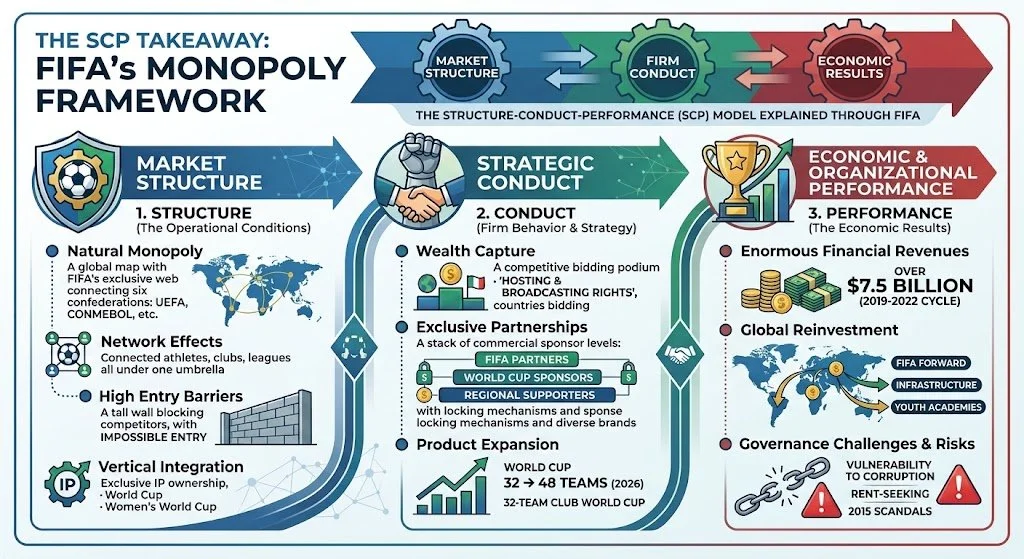
SCP model applied to FIFA
Absolute monopoly = increased corruption?
When an organisation operates as an absolute monopoly, standard market forces that keep firms honest, like customers, price undercutting, or competitor oversight, cease to exist. Under economic theory and the Structure-Conduct-Performance model, this structural concentration of power predictably leads to corruption, rent-seeking, and governance failures for three main reasons:
1. Monopoly Rights and "Rent-Seeking"
In economic terms, economic rent is unearned income generated merely by controlling access to a scarce, high-demand resource rather than creating new value.
Why it happens in a monopoly: FIFA controls an irreplaceable asset, the World Cup and global football rights. Because there are no rival associations, media conglomerates, sponsors, and host countries must go through FIFA to gain access.
The behaviour: External actors engage in rent-seeking, spending huge sums of money not on improving football, but on influencing FIFA's key decision-makers. Bidding wars for broadcasting rights or host selection naturally turn into bribery arenas because winning FIFA's favor guarantees billions in revenue for the winner.
2. Absence of Market Competition
In competitive markets, if a company is corrupt, inefficient, or abusive, consumers and partners leave for a rival.
Why it happens in a monopoly: FIFA operates with massive network effects. Top athletes, clubs, national teams, and commercial sponsors cannot simply leave FIFA to join a competitor; leaving means exile from professional football entirely.
The behaviour: Because FIFA faces zero threat of market entry or customer flight, its leadership experiences no financial discipline or legal pressure from market competitors. This breeds internal complacency and arrogance, enabling officials to treat organisational assets as personal revenue streams (kickbacks for TV rights deals) without fear of losing market share.
3. Structural Governance issues
Monopolies operating on a global scale often suffer from severe principal-agent problems and institutional obscurity.
Regulatory Void: FIFA is registered as a non-profit association under Swiss law, placing it outside the direct jurisdiction of national governments or international market regulators (like antitrust agencies).
Asymmetric Information: External stakeholders (fans, players, tax-paying citizens of host nations) have little visibility into FIFA's internal financial allocations or voting processes.
Voter Distribution vs. Economic Power: In FIFA’s decision-making system (the FIFA Congress), small national associations carry the same single vote as large footballing superpowers. Officials can easily bribe or channel financial development grants to smaller voting blocs to secure long-term political control and shield themselves from internal oversight.
In short, when an entity holds total control over a multibillion-dollar industry without legal accountability or commercial competition, corrupt behaviour is not an anomaly, it is a predictable economic consequence of the structure itself. At least that is what SCP model tells us. I leave it to you to come to your own decisions.